
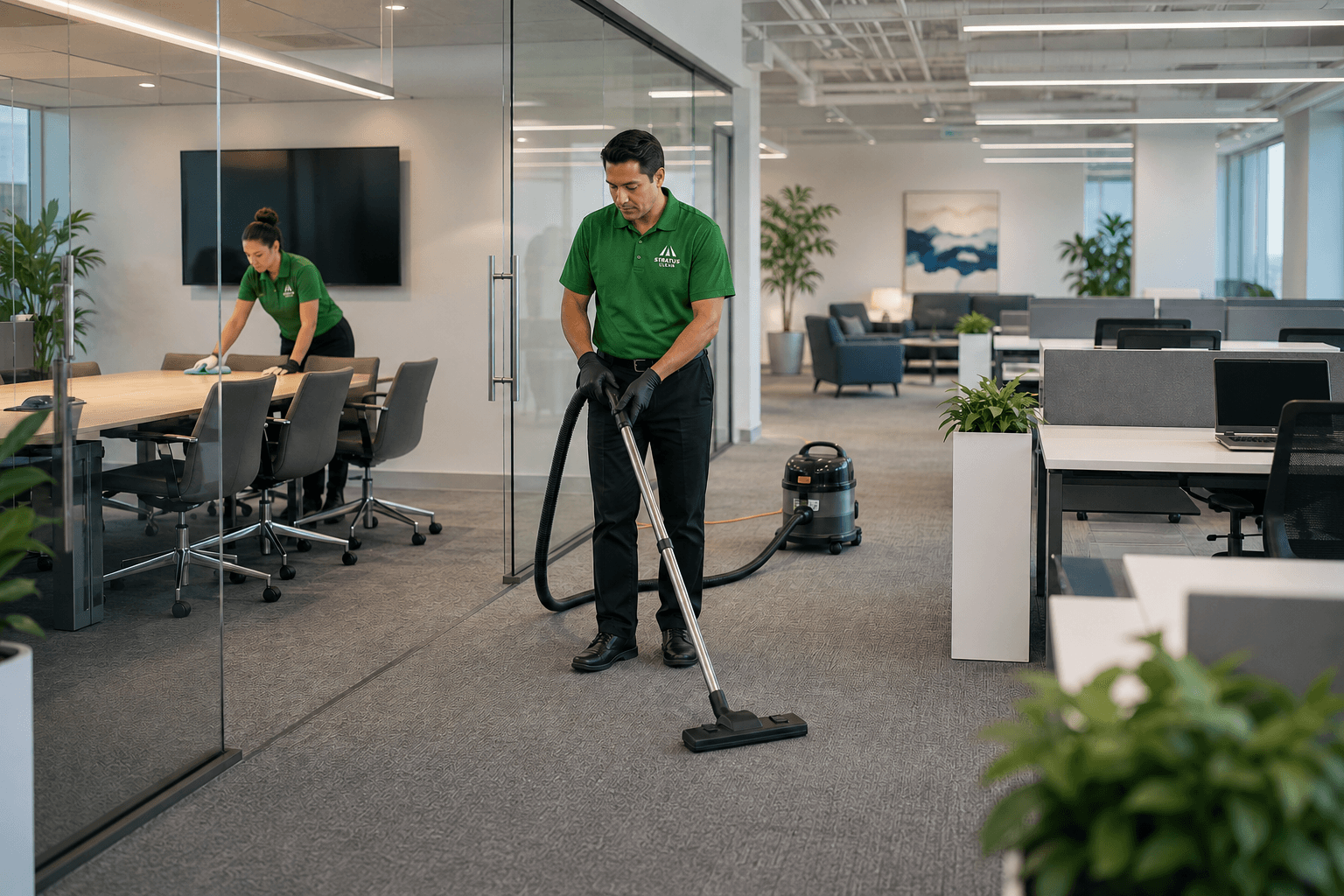
Employees may not inspect every cleaning task, but they notice patterns. Restrooms without supplies, dusty desks, sticky breakroom counters, overflowing trash, odors, stained carpets, and smudged glass all send a message about how the workplace is managed.
Even without a formal survey, office managers can learn a lot by asking one question: where do cleanliness concerns show up most often?
Restrooms are usually the first signal
Restrooms have a direct effect on employee confidence. A restroom can be cleaned every night and still feel neglected if supplies run out during the day or odors are not addressed.
Office restroom cleaning should include:
- Fixtures and counters
- Mirrors and dispensers
- Partitions and doors
- Floors and corners
- Trash removal
- Supply checks
- Touchpoints
- Odor source attention
For busy offices, day porter checks may be needed in addition to after-hours cleaning.
Breakrooms shape the employee experience
Breakrooms collect food residue, spills, odors, fingerprints, trash, and floor soil. Employees often use these spaces several times a day, so small cleaning misses become obvious quickly.
Important breakroom tasks include counters, sinks, tables, appliance handles, cabinet pulls, floors, trash, and spot cleaning. Refrigerator interiors, microwaves, and personal items should be defined clearly because responsibilities vary by workplace.
Shared spaces need clear ownership
Conference rooms, copy areas, reception spaces, phone rooms, and shared desks can fall between employee responsibility and janitorial responsibility. The cleaning scope should define what the cleaning team handles and what employees must clear first.
For example, a cleaning team may wipe an open conference table but not move confidential documents from a desk. Clarity prevents frustration.
Floors influence the whole office
Carpet stains, dull hard floors, dirty entry mats, and dusty corners make an office feel older than it is. Floors need daily maintenance and periodic specialty care.
High-traffic areas include:
- Entrances
- Lobbies
- Corridors
- Conference rooms
- Breakrooms
- Restrooms
- Printer and copy areas
If these areas show wear, consider carpet cleaning, hard-floor care, or a revised routine schedule.
Odors usually have a source
Masking odors with fragrance rarely solves the problem. Restroom odors, trash, moisture, breakroom spills, old food, carpet issues, and poor ventilation can all affect the office.
A better cleaning plan identifies the source and addresses it through cleaning frequency, product choice, trash schedules, floor care, and maintenance coordination.
Employees notice consistency
One missed task may be forgiven. Repeated misses become the story employees tell about the workplace. Consistency requires a written scope, trained cleaners, inspections, and communication.
Office managers can use employee feedback to refine the cleaning plan. If the same complaint appears repeatedly, the scope or frequency may need to change.
Turn feedback into a better scope
Ask employees or department leads:
- Which areas feel least clean?
- Which restrooms run out of supplies?
- Which rooms need attention before meetings?
- Where do odors appear?
- Which floors or carpets look worn?
- Are there busy days that need extra support?
Then use those answers to improve the cleaning proposal.
A simple scorecard for office managers
Office managers can turn informal feedback into a simple monthly scorecard. Rate restrooms, breakrooms, floors, trash, conference rooms, reception, and communication from one to five. Add notes for repeated issues, not one-off accidents. This creates a practical record for the cleaning provider and makes service reviews more objective.
The scorecard does not need to be complicated. Its purpose is to show patterns: a restroom that runs out of supplies every Wednesday, a conference room that needs pre-meeting resets, or an entrance that needs more floor attention during rainy weeks.
Use feedback to adjust frequency
Sometimes the problem is not the cleaner, but the frequency. A busy office may need more restroom checks, a day porter, or a separate floor-care schedule. Employee feedback is most useful when it leads to a specific adjustment rather than a vague request to "clean better."
Better data leads to a better scope.
Share the pattern, not every complaint
When managers report feedback to the cleaning provider, patterns are more useful than scattered comments. "The second-floor restroom runs out of towels twice a week" is more actionable than "people say the restroom is bad." Specific patterns lead to specific fixes.
Stratus Clean Palm Beach helps offices build office cleaning, janitorial service, day porter, floor care, and specialty cleaning plans around real employee needs. Request a quote to review your workplace.