
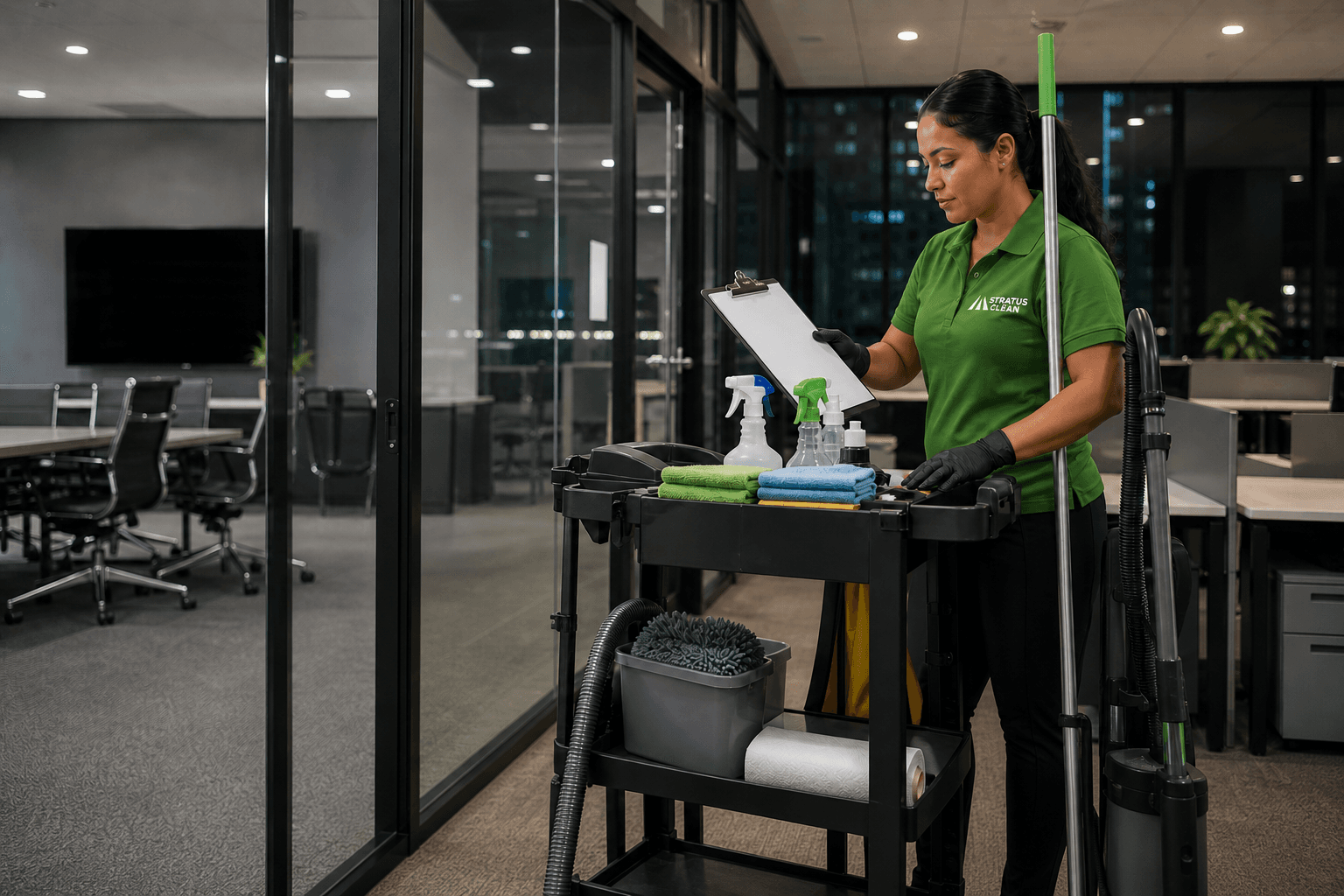
Commercial cleaning tasks depend on the facility, schedule, industry, and traffic level. A small professional office may need basic janitorial service a few times per week. A medical office, school, gym, retail store, bank, or property-managed building may need a more detailed scope with day porter support and specialty services.
The most useful answer is not a universal checklist. It is a structured scope built around the way the building is used.
Core janitorial tasks
Most commercial cleaning programs begin with recurring janitorial tasks such as:
- Trash removal and liner replacement
- Restroom cleaning
- Breakroom and kitchen cleaning
- Vacuuming
- Mopping
- Dusting
- High-touch surface cleaning
- Lobby and reception cleaning
- Conference room resets
- Interior glass touchups
- Spot cleaning
These tasks keep the facility ready from one workday to the next.
Restroom cleaning
Restrooms usually need specific detail because they affect employees, visitors, customers, patients, and tenants. A restroom scope may include toilets, urinals, sinks, counters, mirrors, dispensers, partitions, handles, floors, trash, odor control, and supply coordination.
High-traffic restrooms may need day porter checks during business hours.
Floors and carpets
Floor tasks vary by surface. Routine cleaning may include vacuuming, dust mopping, wet mopping, and spot cleaning. Specialty floor care may include carpet extraction, hard-floor scrubbing, buffing, strip and wax, grout cleaning, or entry mat service.
Floors should be planned by traffic level and surface type.
Offices and workspaces
Office cleaning may include reception areas, private offices, open workstations, conference rooms, copy areas, and shared spaces. The scope should clarify whether desks must be cleared, whether electronics are excluded, and which surfaces the cleaning team can access.
Confidential documents and personal items should be handled by the business before cleaning.
Breakrooms and kitchens
Breakrooms collect spills, crumbs, fingerprints, odors, and trash. Cleaning can include counters, sinks, tables, chair backs, appliance exteriors, cabinet pulls, floors, and trash.
Refrigerator interiors, personal dishes, and employee food should be defined separately.
High-touch surfaces
The CDC recommends regular cleaning of high-touch surfaces. In a commercial building, these can include door handles, push plates, light switches, railings, elevator buttons, faucets, dispensers, shared counters, conference tables, appliance handles, and printer controls.
High-touch tasks should be documented so expectations are clear.
Specialty commercial cleaning
Commercial cleaning may also include:
- Day porter service
- Commercial carpet cleaning
- Hard-floor care
- Window cleaning
- Pressure washing
- Disinfecting services
- Green cleaning
- Post-construction cleaning
- Deep cleaning
- Event cleaning
These services may be recurring or scheduled as projects.
Facility-specific tasks
Different facilities need different scopes. Medical offices need careful boundaries around approved non-clinical areas. Gyms need locker room, equipment, mirror, mat, and odor attention. Retail stores need sales floors, fitting rooms, entrances, and display-adjacent cleaning. Schools need classrooms, restrooms, corridors, cafeterias, and gyms.
Build a task list around your building
Stratus Clean Palm Beach helps businesses define commercial cleaning, janitorial services, facility cleaning, and specialty cleaning scopes. Request a quote to build a task list around your facility, schedule, and service area.
What should be daily, weekly, and periodic?
Daily or every-visit tasks usually include trash, restrooms, obvious spills, high-touch areas, and floors in active zones. Weekly tasks may include more detailed dusting, glass touchups, edge work, and lower-traffic areas. Periodic tasks may include carpet extraction, hard-floor machine work, deep restroom detail, pressure washing, and larger project cleaning.
The schedule should be based on use. A busy restroom may need several checks per day, while a private office may need less frequent detail cleaning. A lobby floor may need daily attention plus periodic machine work. A conference room may need cleaning after heavy meeting days, not only on a fixed calendar.
Why exclusions matter
A good task list should also say what is not included. Examples may include employee dishes, personal desks covered with papers, clinical sterilization, biohazard cleanup, exterior high-rise glass, pest control, or maintenance repairs. Clear exclusions prevent confusion and help the cleaning provider focus on the tasks they are hired to perform.
When the included and excluded tasks are both clear, commercial cleaning becomes much easier to manage.
Use the walkthrough to finalize tasks
The final task list should be confirmed during a walkthrough. Seeing the building helps the provider catch details such as extra entrances, unusual flooring, busy restrooms, secured rooms, supply storage, or event spaces that a phone call might miss.