
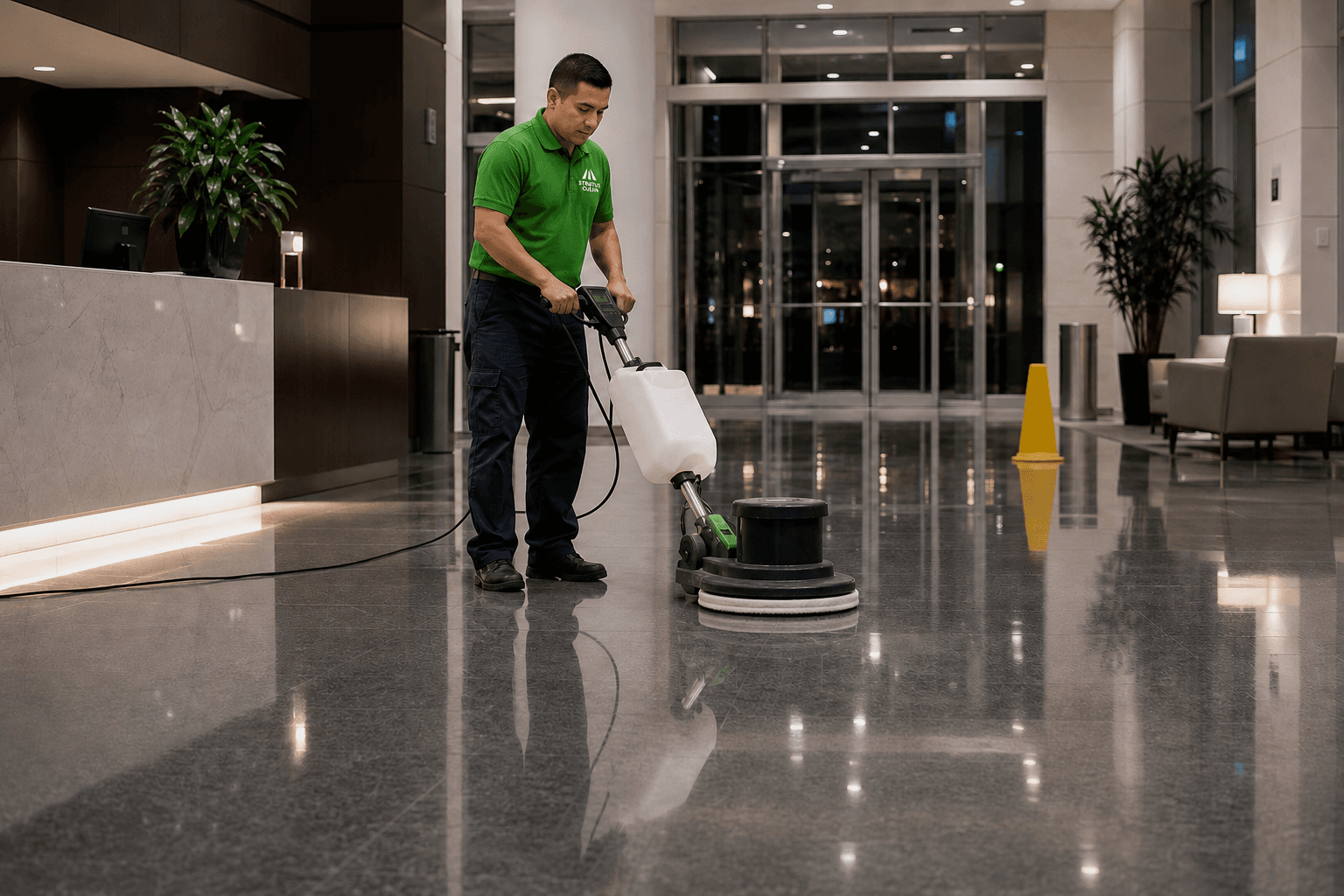
Commercial floors work harder than residential floors. They handle employees, customers, patients, students, carts, chairs, rolling equipment, rainwater, sand, dust, spills, and daily traffic. When floors are not maintained correctly, the whole facility can feel neglected even if the rest of the building is clean.
The best floor care plan starts with the floor material, traffic pattern, and business schedule.
Identify the floor before choosing the method
Different floors need different care. A product or machine that works on one surface can damage another.
Common commercial flooring includes:
- Carpet and carpet tile
- Vinyl composition tile
- Luxury vinyl tile
- Ceramic or porcelain tile and grout
- Sealed concrete
- Rubber gym flooring
- Finished hard floors
- Entry mats
- Stone or specialty surfaces
Before cleaning, confirm the material, finish, manufacturer guidance where available, and any areas with damage or moisture problems.
Start with dry soil control
Dry soil is abrasive. Sand, grit, and dust can scratch finishes, dull floors, and settle into carpet fibers. In Palm Beach facilities, tracked-in sand and moisture can build quickly near entrances.
Good dry soil control includes:
- Walk-off mats at entrances
- Daily vacuuming or dust mopping
- Edge cleaning
- Prompt removal of debris
- Regular mat cleaning
- Attention to corners and under furniture
If dry soil is not controlled, wet mopping may spread residue instead of solving the problem.
Match wet cleaning to traffic
Hard floors need routine wet cleaning, but frequency depends on traffic and soil. Restrooms, entries, breakrooms, corridors, and lobbies often need more attention than private offices.
A good routine should define:
- Which floors are mopped daily
- Which areas need spot cleaning during the day
- Which products are approved for the floor type
- How mop water, pads, and tools are kept clean
- Which areas require machine scrubbing
Dirty tools can leave floors sticky or streaked, so process matters.
Carpet needs more than vacuuming
Vacuuming removes dry soil, but commercial carpet also needs spot treatment and periodic extraction or interim cleaning. Traffic lanes near entrances, reception areas, conference rooms, and hallways often show wear first.
A carpet plan may include:
- Daily or frequent vacuuming
- Prompt spot treatment
- Entry mat maintenance
- Interim cleaning for traffic lanes
- Hot water extraction or restorative cleaning
- Dry time planning to avoid disruption
Commercial carpet care should be scheduled before the carpet looks permanently worn.
Restroom floors need detail
Restroom floors are a common source of odor and complaints. Routine mopping may not be enough if soil builds around partitions, fixtures, grout, drains, and corners.
Restroom floor detail can include edge work, grout attention, fixture bases, corners, and product selection that addresses soil without creating slippery residue.
Do not ignore finish maintenance
Finished hard floors need a maintenance cycle. Depending on the floor, that may include cleaning, buffing, burnishing, scrub and recoat, or strip and wax. The goal is to protect appearance and reduce premature wear.
If a floor looks dull after mopping, the issue may be worn finish, residue buildup, poor matting, or the need for machine work.
Build floor care around the business schedule
Floor work can require drying time, blocked areas, furniture movement, and after-hours access. A medical office, school, gym, retail store, and office building will all need different timing.
Ask these questions:
- Which areas must be ready by opening?
- Can sections be closed safely?
- Is weekend or after-hours service available?
- Are there events or inspections coming up?
- Will furniture or mats need to be moved?
Keep floors in the cleaning plan
Stratus Clean Palm Beach provides hard floor cleaning, commercial carpet cleaning, janitorial floor care, and specialty cleaning for local businesses. Request a quote to build a floor-care plan around your facility.
Floor-care questions for a walkthrough
Before requesting floor service, gather details that affect the recommendation. What flooring materials are in each zone? Which entrances see the most rain, sand, or customer traffic? Are there chairs, rolling carts, mats, or equipment that mark the floor? Are there stains, worn finish, loose tiles, odor issues, or moisture concerns?
Also ask about access windows. Carpet extraction, floor finish work, and machine scrubbing may require areas to be closed while floors dry or cure. Planning that timing prevents safety issues and operational disruption.
Maintenance beats emergency restoration
The most expensive floor problems usually start as small maintenance gaps. A lobby floor loses shine. A carpet lane darkens. Restroom grout starts holding odor. A breakroom floor becomes sticky. Regular inspections and periodic service help correct these issues before they define the facility's appearance.
A practical floor program protects both the look of the building and the life of the surface.