
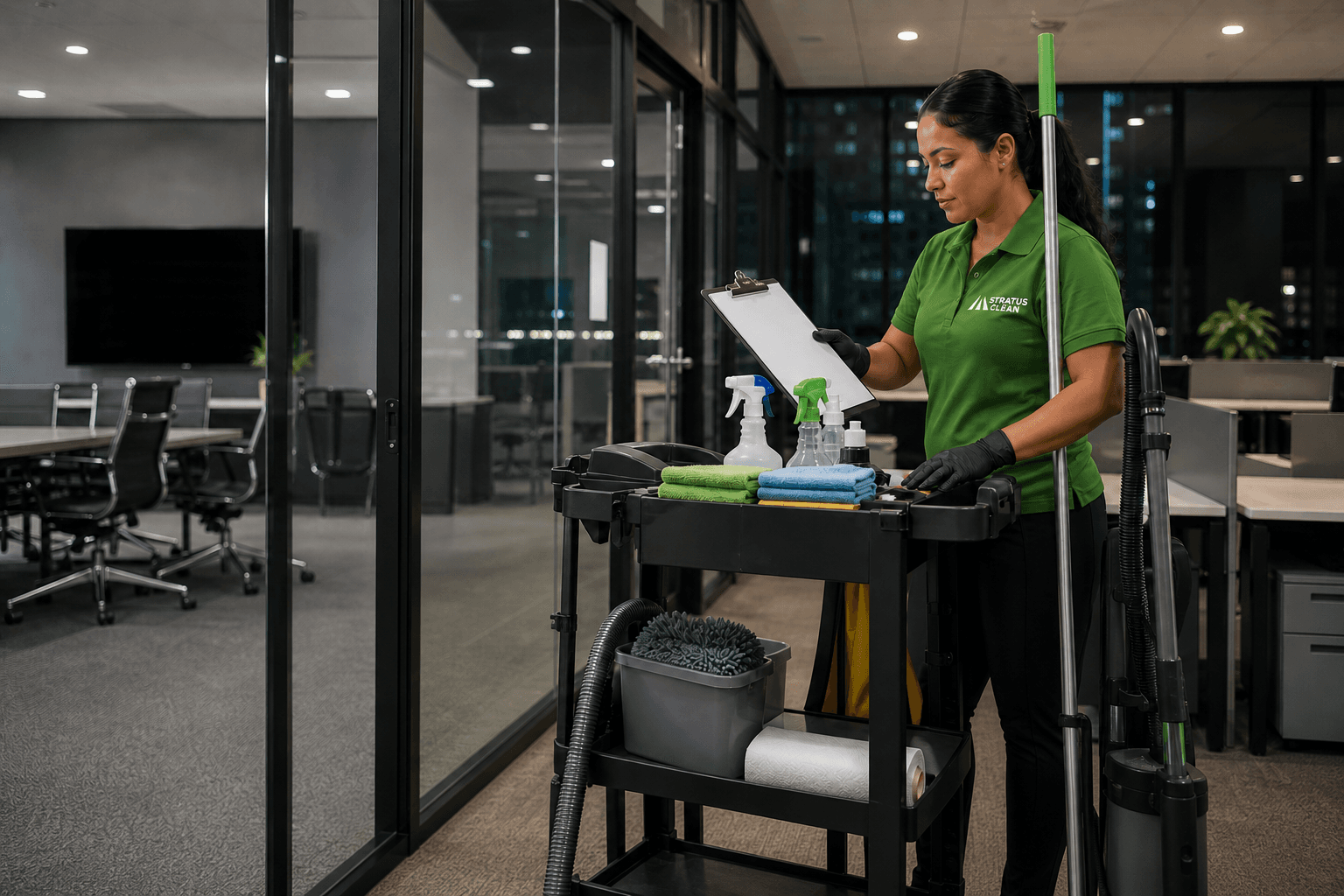
Recurring janitorial service is the foundation of a clean, professional workplace. The right checklist helps office managers set expectations, compare quotes, and keep cleaning consistent over time.
This checklist is designed for offices, commercial buildings, shared workspaces, and professional suites that need reliable cleaning support.
Daily or routine janitorial tasks
Routine tasks keep the workplace ready for staff and visitors. Most office cleaning programs include some version of:
- Trash and recycling removal
- Restroom cleaning and restocking
- Breakroom and kitchen surface cleaning
- Vacuuming carpeted areas
- Sweeping and mopping hard floors
- Dusting reachable surfaces
- Cleaning entry glass and interior touchpoints
- Wiping conference tables and shared surfaces
The exact frequency depends on building size, traffic, and operating hours.
High-touch areas need extra attention
Shared touchpoints collect daily buildup because many people use them repeatedly. A stronger janitorial plan should include door handles, light switches, elevator buttons, counters, appliance handles, faucets, railings, and shared equipment.
These areas are especially important for medical offices, schools, gyms, financial offices, coworking spaces, and multi-tenant buildings.
Restrooms and breakrooms shape perception
Employees and visitors notice restrooms and breakrooms quickly. They also require a clear cleaning rhythm because supplies, moisture, trash, and odors can change throughout the day.
For busy buildings, day porter service may be a better fit than after-hours cleaning alone. A day porter can check restrooms, restock supplies, respond to spills, and keep common areas presentable during business hours.
Add periodic specialty cleaning
Routine janitorial service handles daily maintenance, but many facilities also need scheduled specialty work. Common add-ons include carpet cleaning, hard floor care, window cleaning, pressure washing, disinfecting, and post-construction cleaning.
Planning these services in advance helps protect the appearance of the building and reduces surprise maintenance issues.
Quality control keeps the checklist useful
A checklist only works when there is accountability. Ask how the cleaning provider handles inspections, missed items, special requests, and communication.
Stratus Clean Palm Beach designs janitorial services around facility use, schedule needs, and quality expectations. If your office cleaning checklist is growing but results are inconsistent, it may be time to request a structured janitorial quote.
Turn the checklist into a room-by-room scope
A janitorial checklist becomes more useful when it is organized by space. Instead of using one broad list, separate the scope into reception, private offices, open work areas, conference rooms, restrooms, breakrooms, hallways, stairwells, elevators, supply closets, and exterior entrances. This makes it easier to see whether a task is missing or assigned at the wrong frequency.
For example, reception may need daily floor care, trash removal, glass spot cleaning, dusting, and touchpoint cleaning. Conference rooms may need table cleaning, chair resets, trash removal, and whiteboard attention. Breakrooms may need counters, sinks, microwaves, appliance exteriors, tables, floors, trash, and supply checks.
Daily, weekly, and monthly tasks should be separated
Not every task belongs on every visit. Daily or routine tasks often include trash removal, restroom cleaning, breakroom cleaning, vacuuming traffic areas, mopping hard floors, and touchpoint cleaning. Weekly tasks may include deeper dusting, chair bases, door frames, partition ledges, interior glass, and more detailed floor work. Monthly or periodic tasks may include high dusting, carpet spotting, machine floor care, and detailed restroom descaling.
Separating frequencies keeps the program realistic. It also helps managers understand whether a complaint is about a missed task or a task that was never scheduled often enough.
Communication should be part of the office-cleaning scope
An office-cleaning provider should be able to respond when the workplace changes. A new tenant may move in, the team may grow, a conference room may see heavier use, or a customer-facing area may start receiving more traffic. The cleaning scope should adapt to those changes.
Ask how communication works. Does the provider use a supervisor, account contact, service log, photo documentation, or inspection routine? How are special requests handled? How quickly can the schedule change for an event or holiday? Clear communication makes a janitorial checklist much more than a file in a drawer.
Add facility-specific details
Every office has details that matter. Law firms may need extra attention to conference rooms and client areas. Financial offices may care about secure access and spotless lobbies. Medical-adjacent offices may need carefully defined touchpoint routines. Coworking spaces may need flexible cleaning windows and heavier restroom service.
The more the checklist reflects the actual business, the better the results will be. A good janitorial services provider should be able to recommend scope changes after the walkthrough, not just accept a generic list.
Use the checklist to evaluate results
Once service begins, use the checklist during quality reviews. Walk the space and compare what you see against what was promised. Look at restrooms, floors, trash, dust, breakrooms, lobbies, glass, and high-touch surfaces. If something is slipping, the checklist gives both teams a shared reference point for correction.
Stratus Clean Palm Beach can build office cleaning and janitorial service scopes for recurring maintenance, day porter support, floor care, carpet cleaning, window cleaning, and specialty cleaning across local service areas.